Qsnailfrr Anti-Scald Tongs Review & Test
Introduction
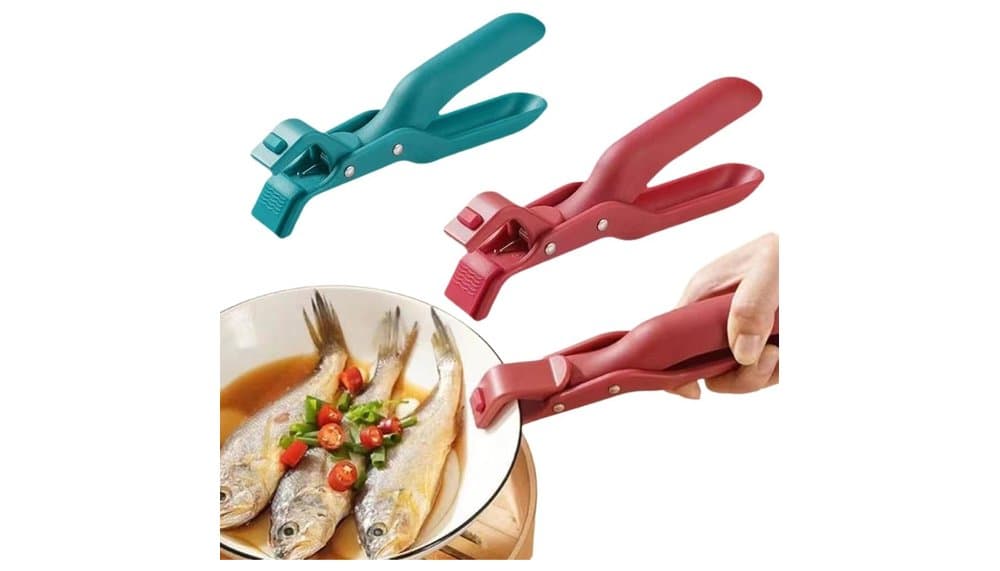
In the demanding world of precision cooking, every tool must justify its place on our work surface. Between the immersion circulator that targets within half a degree and the blowtorch that sears with a flame, the logic is relentless: each piece of equipment must offer total reliability and real utility. Today, we examine an accessory that claims to simplify the handling of hot dishes: the Qsnailfrr Multi-Purpose Anti-Scald Tongs Kitchen Accessories. On paper, it is an insulating tong made of silicone and nylon to prevent burns. But in the context of a kitchen where one handles 85°C water baths for hours, dishes coming out of a 250°C oven, or slippery containers from sous-vide cooking, the promise deserves a cold analysis. Can it become a safety ally, or does it remain a gadget of uncertain durability? We will dissect its specifications, confront its promises with user feedback, and determine its place in an arsenal dedicated to precision.
Strengths
Materials adapted for heat and cleaning. The announced combination of silicone and nylon is a logical starting point. Silicone is known for its heat resistance and insulating properties, while nylon offers some structural rigidity. The fact that they are dishwasher safe is a significant practical advantage for a tool meant to be used frequently.
Ergonomic and versatile concept. The one-handed design and the ability to grip at multiple angles (horizontal and vertical) address a genuine need in a cluttered kitchen. The promise of being able to grasp various utensils (bowls, dishes, lids) in tight spaces, like an oven, aligns well with the real constraints of a cook.
Immediate safety. The primary objective is clear: to create a physical barrier between the hand and the heat, whether from a container, steam, or a dish from the microwave. For a beginner who has not yet developed the habit of consistently using thick kitchen towels, this tool may seem to offer a simple, dedicated solution.
Weaknesses
The crucial question of mechanical reliability. This is the major black spot that immediately emerges from the analysis. Structural fragility is the leitmotif of negative reviews. A tool that breaks on the first try, or that loses grip under the weight of an average dish, does not fulfill its primary function. In a precision kitchen, a failure can mean a lost meal, damaged equipment, or even a physical hazard.
An uncertain grip. Beyond breakage, users report an unstable grip and insufficient clamping force. A tong that does not firmly hold a smooth, slightly damp, or simply heavy container becomes more of a risk than a help. The promised safety is then illusory.
Disappointment with build quality. Reviews describe a product that seems "cheap" and "too flimsy." This strongly contrasts with the robustness expected from an accessory meant to withstand repeated thermal and mechanical stress. In our field, we value tools that last, from stainless steel meat tongs to high-temperature resistant spatulas.
Detailed Analysis in the Context of Precision Cooking
Let's evaluate this accessory not as an isolated gadget, but as a potential complement to a demanding cooking workflow.
For moving sous-vide cooking containers: Ideally, a tong of this type could serve to remove a bag from the water bath or to move the container itself. However, given the feedback on limited gripping force and doubtful durability, we cannot recommend it for this task. A heavy, slippery bag, immersed for 24 hours, requires a firm and flawless grip. The user community highlights slippage on much less critical dishes, which invalidates its use for long cooks where safety is paramount.
For handling finishing dishes: After sous-vide cooking often comes finishing in the oven or on a scorching hot pan. The tool could, in theory, be used to grab a cast iron skillet or a small gratin dish. But here again, the questionable robustness is a major hindrance. A cast iron skillet is heavy and emits intense heat. Testers who saw the tool break immediately warn against its use for significant loads.
Utility for hot accessories: Its most likely and safest utility might be limited to handling hot but lightweight accessories: a saucepan lid, an oven rack, or a small bowl from the microwave. Even in this context, caution is advised based on reported experiences. It will never replace the safety of a high-quality kitchen glove or an insulated-tip metal tong.
Construction and ergonomic design: The design idea is good. The one-handed grip and angle flexibility are theoretical assets. But the nylon and silicone construction, if not molded and assembled with precision, leads to the described problems of excessive flexibility and breakage. For an enthusiast used to the finish of Anova or Joule circulators, or the solidity of FoodSaver vacuum sealers, the perceived quality gap is significant.
Technical Specifications
| Feature | Detail / Announced Spec |
|---|---|
| Product Name | Qsnailfrr Multi-Purpose Anti-Scald Tongs Kitchen Accessories |
| Materials | Silicone, Nylon |
| Color | Green, Red (2 pieces) |
| Dimensions (L x W) | 19.1 x 8.9 cm |
| Weight | 103 g (for the set) |
| Dishwasher Safe | Yes |
| Design | One-handed tongs, multi-angle grip |
| Main Function | Thermal insulation and secure gripping of hot containers |
What Users Say: A Reality Gap
Analysis of customer feedback (particularly on French-language platforms) reveals a clear fracture between the marketing promise and the lived experience. The low overall rating (2.6/5) is telling.
Recurring alerts on quality:
- Immediate fragility: Mentions of "broken on the 1st use," "very fragile item... the item broke," and "it seems a bit fragile" are frequent. This point fundamentally invalidates the tool's premise.
- Lack of reliability: Testers conducted concrete tests, such as lifting a stainless steel dish filled with water, and observed systematic slippage ("both tongs slipped"). One user even reports breaking a glass dish following a drop.
- Unstable grip: Even when it doesn't break, the product is described as having an "unstable grip" and being "a bit too flimsy for my taste," requiring constant "attention."
Positive points noted:
- A minority of users find the product "very practical" and "great" for its intended use, appreciating the concept that "avoids burns." These positive reviews seem to correspond to very light and occasional uses, where the construction flaws have not had a chance to manifest.
The conclusion is unequivocal: the majority trend is disappointment, centered on a glaring lack of robustness and insufficient reliability. In our world where reliability is king – whether it's the stability of a circulator over 72 hours or the perfect seal of a vacuum pouch – these reviews are disqualifying.
Conclusion
The Qsnailfrr Multi-Purpose Anti-Scald Tongs Kitchen Accessories perfectly illustrates the gap that can exist between a good concept and a flawed execution. The basic idea – an insulating and versatile tong – is relevant, especially for beginners looking for dedicated solutions to avoid burns.
However, based on the available data, we cannot consider it a reliable tool for precision cooking. User feedback overwhelmingly converges on the same verdict: a fragile construction and a gripping force unsuited for serious tasks. A tool that breaks on the first test or drops a hot dish does not meet the safety and durability criteria we demand, whether one is a novice moving up or a seasoned enthusiast.
For the safe handling of hot containers, proven solutions exist: quality silicone kitchen gloves, offering dexterity and full protection, or wide-jawed metal tongs with insulated handles, which offer unmatched robustness and grip. These alternatives, although sometimes more expensive to purchase, constitute a safe and durable investment.
In short, despite its laudable intention, this product, as described by the majority of its users, presents a risk profile that is too high to be recommended. In a culinary approach where every detail counts, it is preferable to turn towards tools whose reliability is not a variable to be adjusted.
100% free and independent — All our articles are written independently, without any sponsorship. We may earn a commission on purchases made through our links, at no extra cost to you.
Articles you might like
PHOVOLT WiFi Thermometer with Probe Test
For precise sous-vide & charcuterie, a calibrated core temperature probe is essential to ensure perfect results where it matters most.
KitchenBoss Food Vacuum Bag Roll Review & Test
KitchenBoss vacuum sealing bags for sous-vide: analyze specs, compare performance, and determine value for precision cooking storage and preparation.
Fityou HU-XI-53 Immersion Circulator Sous Vide Cooker Review
Fityou HU-XI-53 Immersion Circulator review: A high-performing, accessible sous vide cooker with 1100W power, precise 0.1°C accuracy, and a 25-95°C range.
Guides you might like
Bell Jar Vacuum Sealer Buying Guide
Upgrade to a chamber vacuum sealer for professional sous-vide results at home. Perfect for liquids and flawless, long-lasting seals.
Best Beginner Sous Vide Kit
Find the perfect sous-vide starter kit on a budget. Learn the three essential features to look for to cook your first perfect steak without the headache.
Best Vacuum Bags
Choose the right vacuum sealer bags for perfect results. Learn key specs like heat resistance, thickness, and barriers to avoid culinary disasters.